Showing posts with label wild garlic. Show all posts

Sunday, 18 April 2010

Nettle Soup

When I tell people that I enjoy foraging for food, I am often asked if I have ever made Nettle Soup.  It seems to embody the very idea of free food from the countryside.  But the answer has always been no.  Last year I fully intended to make some, but left it too late - for the best results you need to gather the nettles when the leaves are young and tender - about now is great.

This year the unseasonably sunny weather kicked me into action, so Rob and I set off this afternoon, armed with gardening gloves, to forage for some nettles.

They're not exactly hard to find!  Once you start looking in any hedgerow or field boundary you soon find plenty - I think they're so common that I often don't even notice them.  We chose a patch that wasn't too close to any well-used footpaths (hoping to avoid nettles fertilised by dog-wee!) and got picking.

The gloves were, of course, invaluable.  Had I thought ahead I would have also worn boots but set off in sandals, only to find my ankle got stung.  But one sting from all those nettle-tops didn't seem too much of a sacrifice (although I had forgotten how much it hurts!)

When picking nettles, you need to pinch out the tops, so you end up collecting the 4 smallest leaves from each plant.  It's immensely satisfying, as foraging usually is, but this time with the added bonus of being able to feel that in some tiny way you're keeping the spread of these pesky plants in check!


We soon managed to gather the requisite half-carrier-bag-full needed, and rinsed them well in cold water (wearing washing-up gloves this time!).  They're really quite pretty leaves when you look closely at them - but it's those fine hairs that cause the stings.  Luckily boiling water neutralises them within seconds.


I found many recipes online, but ended up making up the soup using what I had, including a handful of the wild garlic leaves collected yesterday, making it a well-foraged soup!  This is what I did:

Nettle Soup

Chop one large onion and one large potato (unpeeled) and gently soften in a large pan (use olive oil or butter).

Add half a pan full of stock (I used chicken) and bring to the boil, simmering until the potatoes are tender.

Add the nettles (half a bag full) and a large handful of wild garlic (or saute a chopped clove of garlic with the onion and potato at the beginning of the process), stir, cover and bring back to the boil for 3 or 4 minutes.  The leaves will darken a little and wilt down, much as spinach does.


Blend the soup until smooth (I used a stick-blender), and stand back and admire the vibrant green colour!  Sample and season with salt and pepper as needed; I found that it needed quite a lot of both.


When I reheat it I will stir a little cream through each bowl just before serving, to make it a little more luxurious.  I have sampled some already of course...  the nettles don't have a strong flavour, it just tastes quite 'vegetabley' to me, but delicious all the same - and virtuously healthy too!

Whilst foraging, we were passed by a couple out on a walk who were intrigued by what we were doing.  I think foraging for food appears rather eccentric to those who don't do it..!  The woman said that she had once had Nettle Beer... could this be our next project?!

Wild Garlic Tips

For those of you who might be interested in sniffing out some wild garlic yourself, I have a few hints and tips.  I have found 3 patches of it in my local area.  All 3 are in deciduous woodland, and 2 of the 3 in places where bluebells are also found.

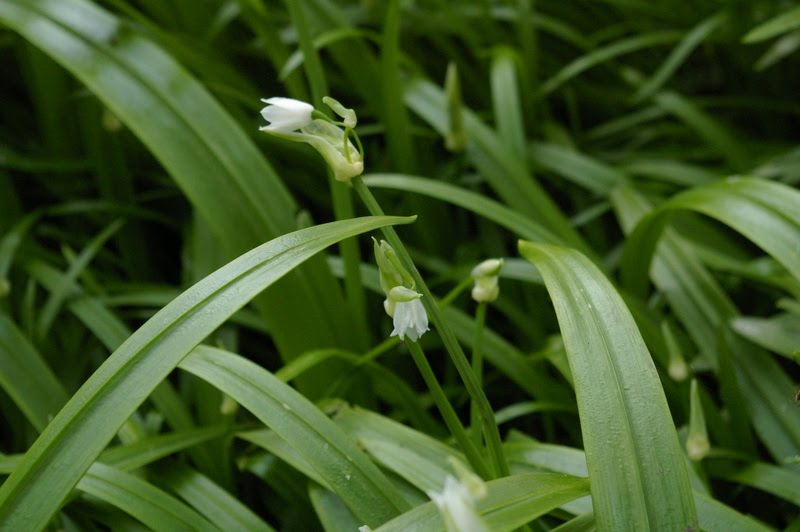
I have noticed that there seem to be 2 different varieties of wild garlic...   The one with long thin leaves that I blogged about recently:


And one with much wider leaves, which I think is possibly the more common variety:


Here's Rob collecting from the vast patch of them that we stumbled across on a walk yesterday.  From my nibblings, I think that the wider-leaved garlic has a stronger flavour...  Rob was certainly complaining about my garlic-breath for hours after I ate a mere half a leaf yesterday!

Both varieties have small white flowers, and the leaves begin to turn yellow and die back soon after the flowers have blossomed.  There's quite a short window of opportunity for gathering the leaves to eat.

We filled our sandwich box with them, and I have made another batch of pesto, as well as using them as an ingredient in a soup.

Here is a wider-angle view of the patch, to give you an idea of the kind of woodland in which you need to search:


In my experience you sometimes smell the leaves before you see them.  I did notice a few plants growing individually in the woods, but mostly I think the plant seems to grow close together with many others, creating these dense areas of garlicky leaves.

Happy Garlic-Hunting!

Saturday, 10 April 2010

Wild Garlic Pesto

Winter has been a lean period for foraging - but one that has seen us enjoying the fruits of our labours.  For months now we have been eating homemade jams, apple chutney, hedgerow jelly, spiced damson sauce and chili jelly, to name but a few.  It's been great, but I've been keen to get out and find more wild food.
Last week I struck lucky.  We were returning from a walk and within 5 minutes' of home I suddenly smelt the unmistakable scent of wild garlic.  I first used this last year, and realised that the season is all-too-brief - the leaves quickly turn yellow, so need to be grabbed when fresh and green.  I raced home to get a bag, then came straight back out to gather some leaves.


Last year I had eaten them as part of a salad, and also stirred them through cooked pasta along with some homemade walnut pesto, but I wanted to try and make them a bit more of a feature in their own right this time.


I decided to turn them into a pesto.  Loosely following a recipe that I found in one of Hugh Fearnley-Whittingstall's books, I blended the garlic leaves - 2 large handfuls - with about 50g of toasted pine-nuts and about the same amount of grated Parmesan.  I drizzled in EVOO to bring it all together, before seasoning with salt and pepper.

OK, it might look a little like alien-goo, but the garlicky smell wafting up from it was wonderful.  We ate it stirred through cooked pasta and topped with crispy bacon and shaved Parmesan.  Delicious.

I'm currently away on holiday (in Shropshire - about which more in another post) but I'm really hoping that that patch of wild garlic is still there when we return.  I'd like to forage further!

Monday, 1 June 2009

Foraging

I've always thought that Autumn was the best time for foraging for food. All those blackberries, hazelnuts, rosehips... But I'm beginning to realise that Spring is just as good - if not better- for harvesting some free food from the hedgerows.

This burst of sunshine over the last week has been amazing, it really lifts the spirits (especially as it coincided so neatly with the half-term holiday). I couldn't help but notice that the hedges are beginning to be dotted with beautiful cream-coloured elderflowers, so headed out on my bike with a basket.


I was a little early to be doing this to be honest - many of the flower-heads were not quite blooming, and many that were were way too high up for me to reach. However, I did manage to fill my basket and soon I was at home rediscovering just how simple it is to make elderflower cordial.


I think that I got this recipe from my parents, several years ago. We have made it before, but didn't make any while we lived in Canada - in fact I struggle to remember whether I even saw elder trees in Ontario..?

Anyway, you simply mix together 40 heads of elderflowers, 3oz citric acid (I got mine from the chemist - just ask at the pharmacy counter), 3 1/4 lb sugar, 2 sliced lemons and 3 pints of boiling water. Mix everything in a large container - a bucket is great, I used a washing-up bowl - cover and leave for 5 days. Helpful hint - rinse the flower heads very well. I have quite a few bugs floating in my cordial! They will of course get strained out. And it's only a bit of extra protein...

After a few days, strain and bottle it. I also like to freeze tubs of it so that it can be scooped straight into a glass and topped up with water, meaning that there is no need for ice-cubes. This also stops the cordial fermenting as can happen if you bottle it.


On the subject of fermenting, I would really like to try elderflower champagne too... I have found several different recipes online for this, some very different from others, but think I'm going to go with Hugh Fearnley-Whittingstall's recipe, which can be found here. I'll let you know how it goes...

My other foraging success has been wild garlic. We discovered this last week, growing in Wendover Woods, so gathered a bag full. The leaves have a very delicate garlicky flavour, almost more like chives, and they can be used like any leafy vegetable.


They are lovely eaten raw as a salad leaf, but I used mine chopped and stirred through cooked pasta with my homemade walnut pesto.


I cycled up to the woods again today to collect some more (to be added to my salad tonight) and found that the leaves of the plants are beginning to turn yellow. I managed to collect enough bright green ones for supper, but I think it's nearing the end of its season. I'm glad we caught it when we did.

Do you forage? What for? Have you ever made Nettle Soup? That might be my next challenge...