Sunday, 21 November 2010

The Pondok

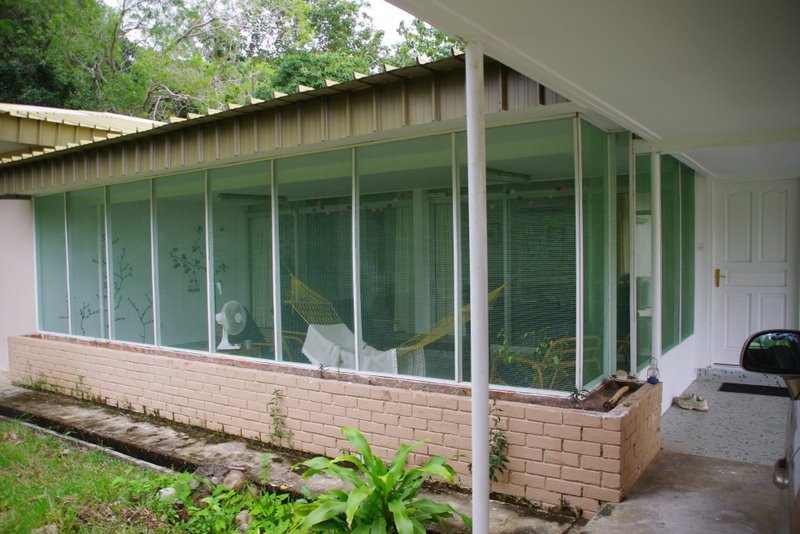
Before our arrival in Brunei I remembering hearing about all kinds of bizarre things and wondering what on earth they were...  one of which was a Pondok.  Well, I'm pleased to report that we have our very own pondok now - here's the shots before...


and after:


The pondok is an extra room on the side of the house, but ours has mesh instead of windows - so it's kind of inside/outside at the same time!  The idea is that the wire mesh keeps the monkeys out (which works), and the plastic mesh keeps the mosquitoes out (which doesn't really...  oh well, we have citronella candles).  The hammock has proved an excellent addition, although we find ourselves fighting to get to it first every evening!


Although in this shot it looks like the view out of the pondok is the car, the main attraction is that the sun goes down in that direction, so we like to sit in here and watch the sunset, listen to the call-to-prayer from the local mosque and enjoy a 'sundowner' (usually a gin and tonic).  I'm not sure those last two things are mutually compatible...

The sunsets here can be pretty dramatic, so it's worth the occasional bug-bite to see them.


Our fairy lights from Vietnam add to the ambience.


However, it's been bothering me that the ponkdok still looks a little empty.  It's an awfully large space and we don't have that much to fill it.  The huge blank wall at the end of the room certainly wasn't helping...  so I was delighted when I found these fantastic stickers in a local shop (WW Mart, for my Bruneian friends).


The designs are great, but unfortunately they come with no instructions whatsoever, and only a miniscule picture of what the finished product should look like.  Still, I managed pretty well with the first one:


I was pleased with this - very sweet I thought.

The second one wasn't quite so straightforward so I ended up chucking the picture away and going completely off-piste, making it up as I went along...


Hmm, not quite so successful, but I do like the overall effect (I didn't use the second birdcage sticker).  It seems to make the room look a bit more finished.


I won't know which way to look when I lie in the hammock this evening (Rob's not here so I'm guaranteed to get to it first!)

Monday, 15 November 2010

Remembrance

In January 1942 Labuan, a Malaysian island off the coast of Brunei, was invaded by the Japanese.  This lead to a campaign to capture Borneo, and the sole Allied Force surrendered in May of the same year.  Devastating bombing of the Japanese position in Borneo was carried out over the next 4 years, and the island was finally recaptured by the Allies in June of 1945.  In the months prior to this however, the Japanese decided to move thousands of prisoners of war from Sandakan (in Sabah) to Ranau, more than 160 miles inland, in anticipation of the Allied attacks.  These became known as the 'Death Marches', and of the 2000 British and Australian servicemen who left Sandakan, only 6 survived.  These 6 men owe their survival to local families who took them when they escaped from the marches.

When the Australian Army Graves Service entered Borneo, they followed the route from Sandakan to Ranau and found many unidentifiable victims of these infamous marches. These and other casualties from battlefield burial grounds and from scattered graves throughout Borneo were taken in the first instance to Sandakan, where a large number of prisoners of war were already buried. This flat coastal area, however, was subject to severe flooding and it proved impracticable to construct and maintain a permanent cemetery. The Sandakan graves, numbering 2,700, of which more than half were unnamed, were therefore transferred to Labuan War Cemetery, specially constructed to receive graves from all over Borneo.  (Taken from the Australian Dept of Veterans' Affairs website).

Every year a multi-faith ceremony is held at Labuan, and we were privileged to attend this year, along with several other members of the British Loan Service Team from Brunei.  It was an incredibly moving service, particularly so when we walked around the cemetery and saw just how many of the 3908 graves are unnamed. 


Wreaths were laid by representatives from many organisations, including the Loan Service in Brunei. 


The Malaysian Armed Forces did an amazing job on parade in such gruelling temperatures, maintaining the dignity and solemnity of the occasion.  It was a humbling and emotional occasion.  

Monday, 8 November 2010

Happy Divali!

I'm a little embarrassed to admit that I don't know that much about Hinduism. I don't remember learning about it when I was at school, and it's not something I've ever had to teach about during my 13 years as a classroom teacher.

However, I recently visited my first Hindu temples, one in Kuala Lumpur (where we stayed for a night at either end of our trip to Saigon) and one in Saigon.  I found them fascinating - so open, welcoming and friendly... and so brightly coloured too! 

The first thing you notice as you approach the Sri Mahamariamman Temple in KL are the rows of stalls where people are busily making and selling garlands.  The smell of the jasmine blossom and the limes was incredible.


I quickly realised that there's a real focus on food in the temple!  These beautifully presented bananas had - I think - been left as an offering.


Statues of many Hindu gods.


Here's one I recognised (thanks to Darren!) - Ganesh.  Someone had left him an orange and some flowers.


There was a very relaxed atmosphere in the temple.


The building is topped with an amazingly colourful and detailed 75-foot-high tower. It is covered with depictions of Hindu gods and goddesses.


The women were wearing the most beautiful jewel-coloured saris.


As we were walking around, a ceremony was taking place.  It was fascinating to watch.  This is a very poor photo (I felt uncomfortable taking pictures during an act of worship), but I wanted to capture it so I could find out what it was all about...   They were pouring buckets of what looked like juice over the statue of the god.


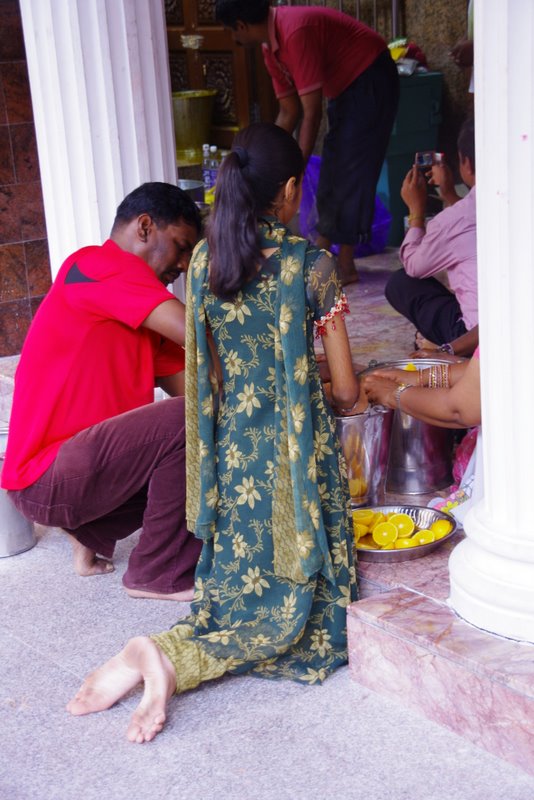
These people were busily juicing oranges to add to the buckets.  The surrounding floor was also littered with other fruit and vegetables, so I don't think it was just oranges that were being used.


If anyone knows the background behind this ritual I would love to hear about it.


The Hindu temple in Saigon was equally beautiful and brightly coloured and people were leaving garlands and offerings of food and fruit.  The fragrance of incense was also very noticeable as worshippers were lighting incense sticks, praying to the gods and leaving the sticks burning in urns such as this.


This little boy was very interested in me and my camera!


Lighting the incense sticks.


It was only on our journey back to Brunei, when we stopped off in KL once again, that we realised that Divali was approaching - Hindu New Year.  We walked past many banners advertising the Divali celebrations in the city.  We were also intrigued to see these gorgeous designs (Rangoli Patterns) being created around the city (we saw one in the airport, and several in shopping malls) - they were made of coloured rice. 


I'm pleased to say that this week I am also teaching my class about Divali, focusing on the story of Rama and Sita.  The message of Divali seems appropriate to us all - may good triumph over evil, and may our lives be full of light.

Sunday, 7 November 2010

A Week in Saigon - Some things we DIDN'T try...

I've already written about how I love Vietnamese food...  but there are some things that I just couldn't face.

Birds' Nest Soup - soup made from the nests of the Cave Swift, a bird renowned for building its nest from its own saliva.  Spit soup, mmmmm!


Weasel 'special' coffee - coffee beans that have been eaten and subsequently pooped out by weasels.  There's just no need for that.

Saturday, 6 November 2010

A Week in Saigon - Eating Out

I had a suspicion that I was going to love Vietnamese food, but this was purely based on 2 lunches I had at a Vietnamese restaurant in Alliston, Ontario, when I was about to leave Canada!  However, my hunch was right - I adore Vietnamese cuisine.

It's full of zingy flavours, with lots of fruit, herbs and vegetables.  It's also generally pretty healthy as it often includes very little oil.  I have yet to attempt cooking any Vietnamese dishes at home, but one of the mums at my school who is Vietnamese has told me that she sometimes runs cookery classes in her home, and has said she'll invite me along to the next one - I can't wait.

Whilst in Saigon (which I suppose I should really be calling Ho Chi Minh City, its official name) we ate out every day.  On our first evening there we discovered the Night Market which springs up in the streets every evening as the indoor market, Ben Thanh, closes.  It was amazing watching the 'restaurants' appear - gazebos would be erected, barbecues lit, chairs and tables put out, and within what seemed like minutes they were open for business.


 Baffled by the choice, and basing our selection purely upon which sold the cheapest 'Bia Saigon' (10,000 dong - 50c US!) we settled down for a snack.


We chose Rice Paper Rolls, delicious prawn and noodle-filled rolls which also included a healthy handful of various herbs - Mint, Thai Basil, and others we couldn't identify.  They were served with a gorgeous dipping sauce, a little like the Thai nam prik num, but sweeter - made with fish sauce, lime juice, chili and sugar.  I've found a recipe for the rolls and sauce here (an Australian food site!)   We also ordered some fried spring rolls which were nice, but felt rather unhealthy compared to the other rolls.

The local beer was great.  And at roughly 30p (UK) per bottle, you certainly couldn't complain!  We've got very used to not having an alcoholic drink when we eat out in Brunei, so it seemed like a real treat to be able to enjoy a chilled lager (or 3) with our meal.


Breakfast the following morning in our hotel proved to be a very exciting buffet.  They had attempted to cater to both western and Asian tastes, and Rob did try a great-British-fry-up once...


But of course the best option turned out to be rice porridge with condiments (a new favourite of mine, and something we have started making regularly at home), followed by fried rice and vegetables, topped with a fried egg.


Thus fortified by breakfast we would head out to explore the city.  It was a source of great stress to me that we didn't often eat lunch - what a wasted opportunity!  But we were usually so full after breakfast that we couldn't manage the next meal.  However, it always amused us to see that the locals had no such worries and would stop for lunch wherever they were and whatever they were doing...


It was a great time to wander around the markets as the stall-holders were too busy eating to grab you and attempt to thrust touristy t-shirts upon you.

Of course it wasn't long before we sampled the famous Vietnamese soup, Pho.  Pho shops and stalls were everywhere - this one sold itself on the fact that Bill Clinton ate here on a presidential visit.


We however chose to eat at Pho 24, a countrywide chain of Pho restaurants that came highly recommended in our guidebook. 


We ordered Pho with beef fillet, and watched as they ladled out a dish of steaming broth then dropped in the thin slices of raw meat, which were cooked as they hit the hot soup.  The soup is full of noodles, but was served with a large plate of herbs, beansprouts, chilis and lime wedges to add to taste.


Sluuuuurrrrrrrpppppppp!


Delicious.

During our day out to the Mekong Delta we ate lunch at a great little restaurant that served lots of fresh Mekong-caught seafood.  This crispy-fried fish was shredded for us and piled into rice pancakes.


Pudding in Vietnam was usually fruit.  This stunning array was served with a small bowl of chili-salt in which to dip the fruit.  The sweet mango and pineapple were particularly nice eaten like this.  Note the ubiquitous Vietnam-grown Dragon Fruit.


We revisited the Night Market several times during the week, and soon began to scour the menu for more exciting dishes.  Some however proved a little too exciting, even for adventurous foodies like ourselves...


We settled instead for 'Roof Tile Beef' which we had seen being served on an adjoining table.  It involved being presented with a barbecue-in-a-bucket which was placed on the table, with an earthenware roof-tile on the top.  A small bowl of oil and a plate of thinly sliced beef was then brought to the table, and you proceeded to cook your own beef on the tile.


It was a hot business, but by the time we ordered it a second time another evening, we were getting quite professional!


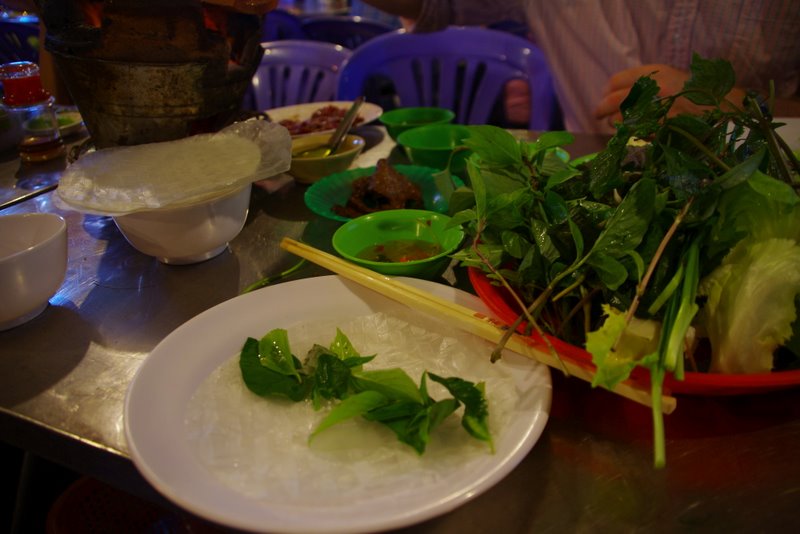
To serve the beef we were given a plate of rice pancakes, cooked rice vermicelli and an absolute heap of greenery - lots of herbs, lettuce and spring onions, as well as various dipping sauces for the finished rolls.

Greens first...


Then noodles...


Then the beef (perfectly cooked!)...


And roll, dip and eat.


If anyone can recommend any Vietnamese cookbooks, or perhaps have tried some great Vietnamese recipes, I'd love to hear from you.